
Rigor: What do we really mean? And why inquiry sits at the heart of it
Recently, I facilitated a parent session at Jakarta Intercultural School focused on a word we use often… but don’t always stop to define:
Rigor.
As I listened to parents share their thinking, I was reminded how powerful and persistent our assumptions about learning can be.
Rigor can be described as:
more work
harder work
more worksheets
getting the right answers
doing things quickly
longer numbers
But here’s the tension:
What we often see as rigorous is not always what is rigorous.
The Problem with What We Can See
In classrooms, rigor is often associated with what is visible:
completed tasks
full pages
correct answers
neat presentation
But these are indicators of completion, not necessarily thinking.
Because rigor is not about how much students produce.
Rigor is about the depth, complexity, and quality of thinking students engage in.
And that kind of thinking isn’t always immediately visible.
Rigor Lives in the Thinking
When we shift our lens, rigor becomes much clearer.
Rigor is not:
recall
more work
harder numbers
faster answers
longer tasks
Rigor is:
Deep thinking – going beyond surface-level responses
Conceptual understanding – seeing relationships and big ideas
Transfer – applying learning in new and unfamiliar contexts
Reasoning – explaining not just what, but why
Flexibility – approaching ideas from multiple angles
Critical thinking – analysing, questioning, and evaluating ideas
Considering perspectives – recognising there isn’t always one answer
Metacognition – reflecting on and adjusting thinking
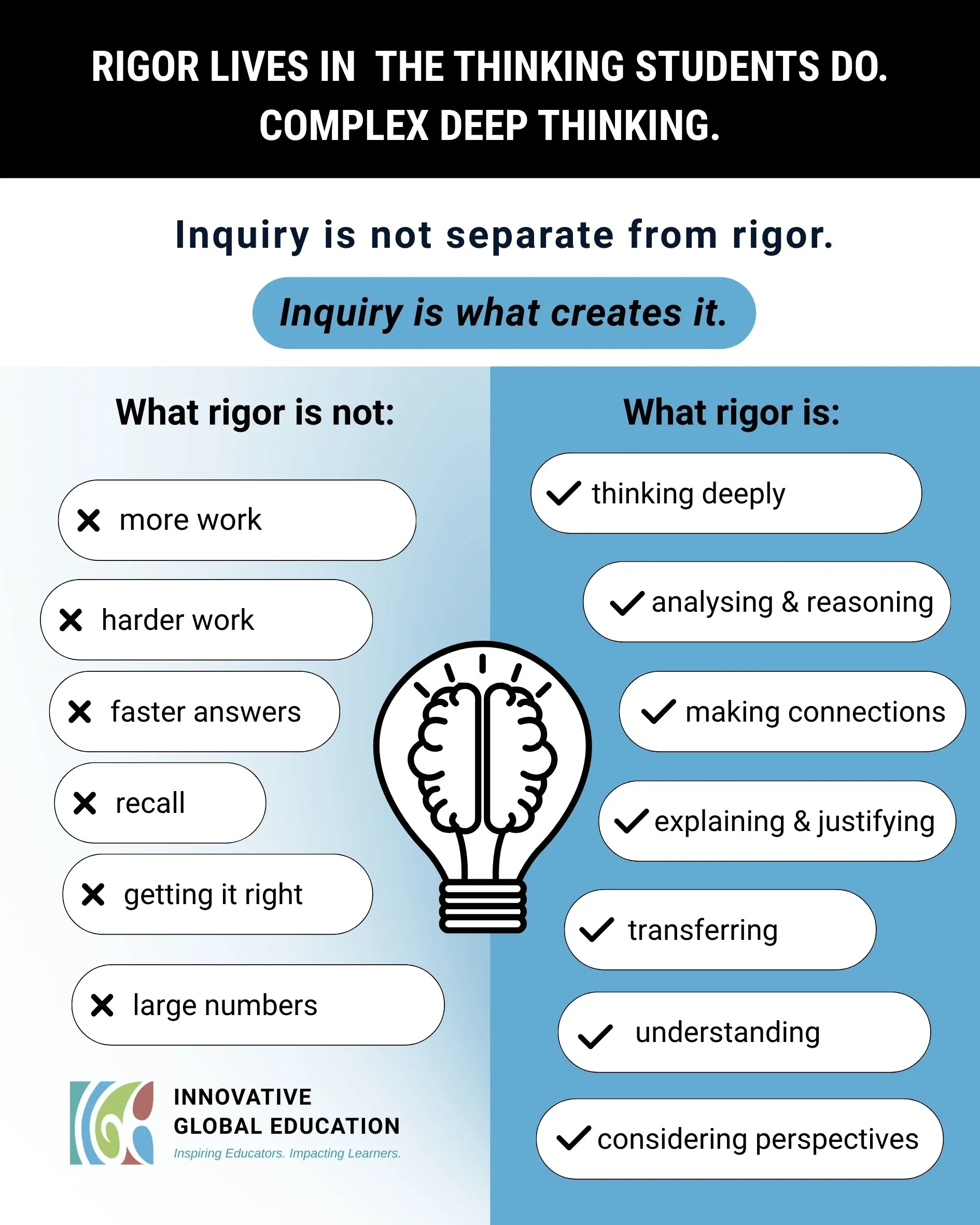
As explored in the session, rigor is grounded in thinking such as analysing, questioning, justifying, and explaining, not simply recalling information.
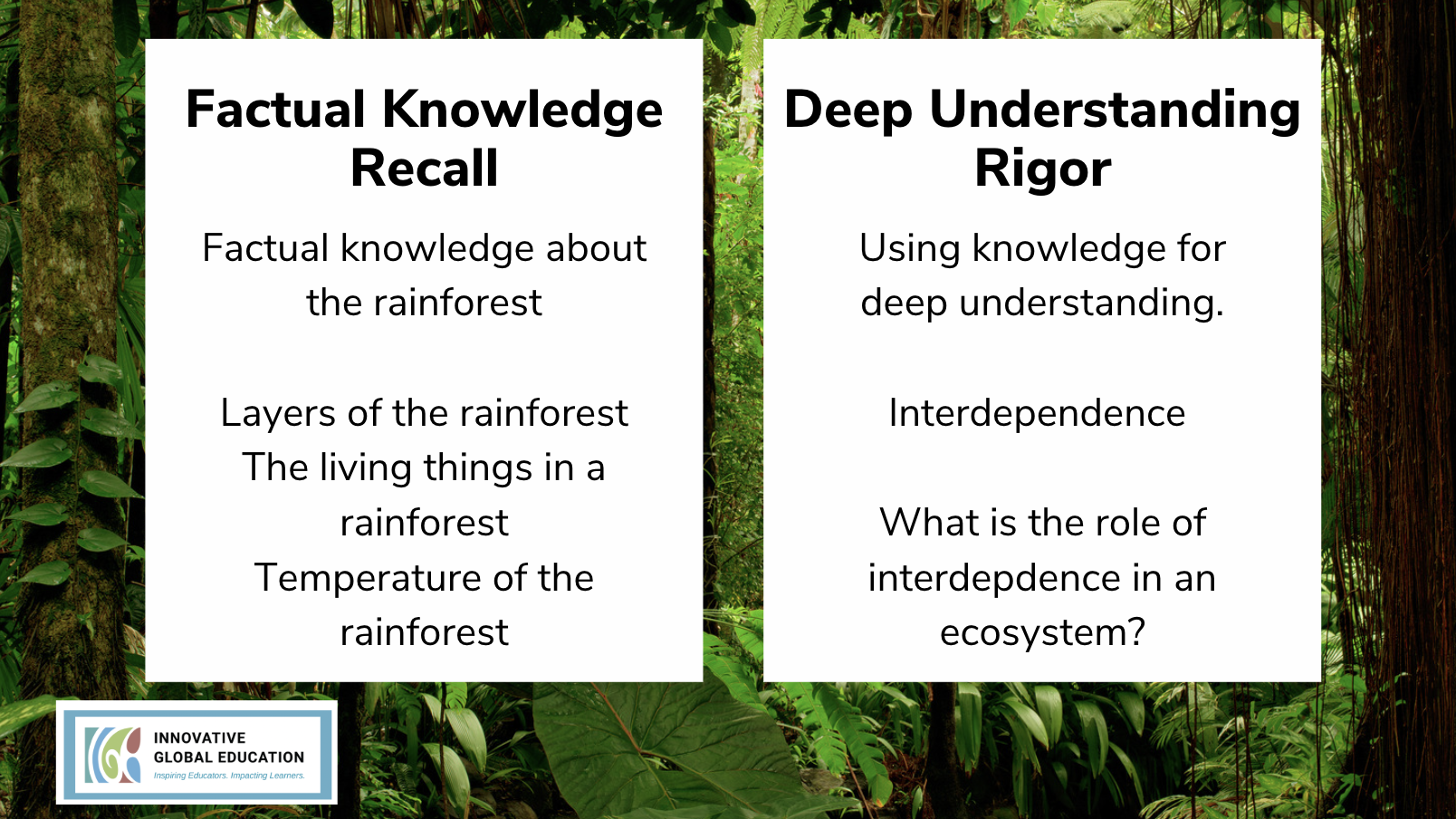
Students go from recalling facts about a rainforest:
Layers of the rainforest
The living things in a rainforest
Temperature of the rainforest
To deep understanding where they make connections between all of those ideas and exampling the role of interdependence in a rainforest. This shift requires deep thinking and rigor, using factual knowledge to build deeper understanding.
TheWorld Economic Forum Future of Jobs Report (2025) highlights that some of the fastest-growing skills include creative thinking, analytical thinking, resilience, flexibility, curiosity, and lifelong learning; capabilities closely connected to rigor.
Inquiry and Rigor Are Interconnected
One of the most important shifts we need to make is this:
Inquiry and rigor are not separate.
Inquiry is not an “add-on.”
It is not something we do after the “real learning.”
Inquiry is what creates the conditions for rigor.
When students are:
exploring and wondering
asking questions
investigating ideas
analysing information
testing and revising thinking
justifying and defending their thinking
considering different perspectives
They are engaging in rigorous learning. This is not incidental. It is intentional.
As Kath Murdoch (2015, p.15) explains,
“Inquiry learning is an approach that demands high-order thinking. The student is continually challenged by the teacher, and tasks are designed to prompt students to question, predict, gather, analyze, synthesize, and reflect.”
Inquiry invites complexity.
It asks students to sit with uncertainty, to navigate multiple possibilities, and to make sense of ideas, not just reproduce them.
And that is cognitively demanding work.
What This Means for Us as Teachers
If we redefine rigor in this way, it shifts our role.
We begin to design learning that asks:
Where is the thinking in this experience?
Are students analysing or simply following steps?
Do students have opportunities to question, challenge, and consider perspectives?
Are they making meaning, or just completing tasks?
Are they justifying and reasoning in connection to their learning?
It also shifts what we notice.
We start to look beyond:
correct answers
and begin to value:
how students are thinking
the strategies they choose
the questions they ask
the connections they make
how their thinking changes over time
Because these are the indicators of rigor.
When Rigor Doesn’t Look Like Rigor
Rigorous learning doesn’t need to look like:
quiet classrooms
students working independently
fast completion
It can look like:
discussion
disagreement
uncertainty
revision
multiple perspectives
Sometimes it looks messy.
But that mess is not a lack of rigor.
It is evidence of it.
A Final Reflection
If learning is about completion,
then a worksheet works.
But if learning is about:
understanding
independence
critical thinking
navigating complexity
and preparing learners for an ever-changing world
then we need something more.
We need learning that invites students to:
question, analyse, interpret, and make meaning.
We need inquiry.
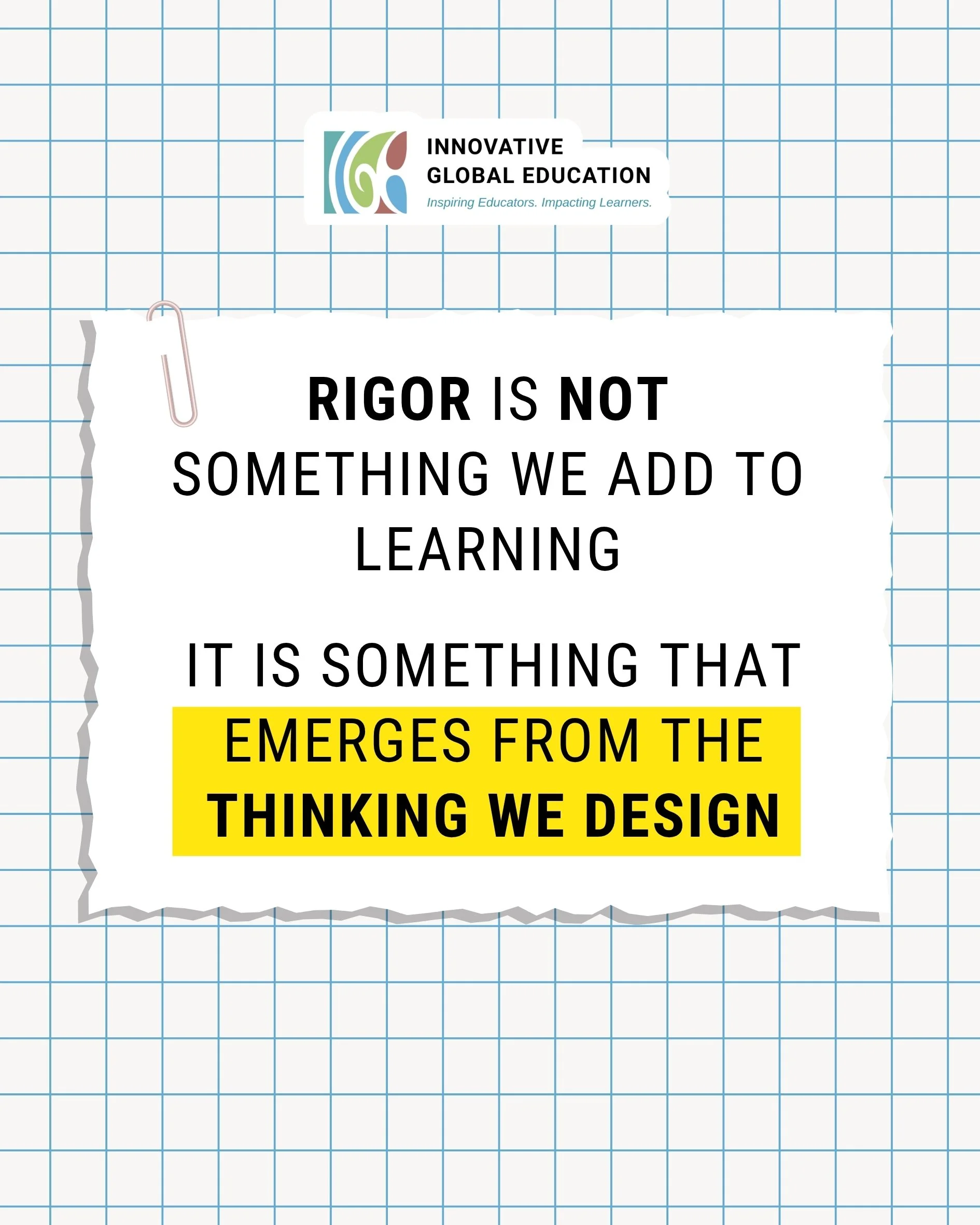
And we need to remember:
References:
Murdoch, K. (2015). The Power of Inquiry: Teaching and Learning with Curiosity, Creativity and Purpose in the Contemporary Classroom. Seastar Education.
World Economic Forum. (2025). Future of Jobs Report 2025. World Economic Forum. https://www.weforum.org/reports/the-future-of-jobs-report-2025