
Teachers Don't Just Teach the Curriculum. They Design It.
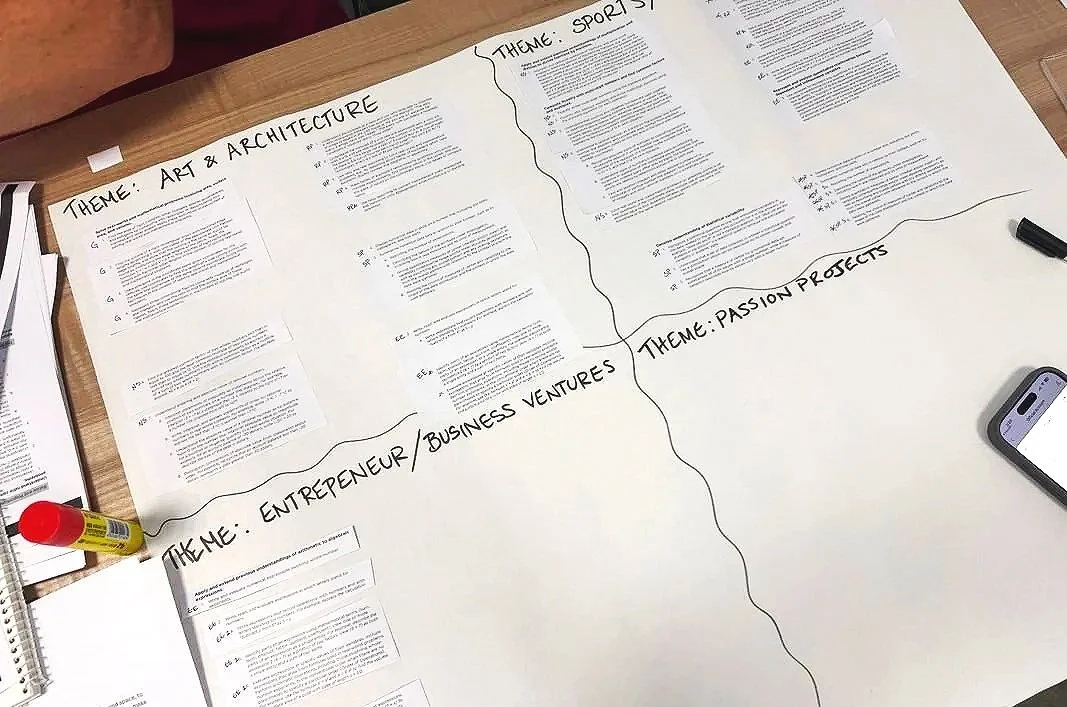
Designing Curriculum: Allison Nave and John Willoughby at Shanghai American School.
Recently, I found myself reflecting on a conversation I had over a year ago with Allison Nave and John Willoughby at Shanghai American School.
They were exploring what it might look like to think differently about curriculum design in Mathematics. Rather than organising learning around isolated strands, they wanted to shift the learning to authentic, meaningful experiences that naturally bring multiple mathematical ideas together.
When I recently had the opportunity to reconnect with them, it was inspiring to see how that thinking had evolved in practice.
One comment, in particular, stayed with me.
One of the biggest concerns they had at the beginning was one I hear repeatedly from educators around the world.
"Will we still cover the standards?"
Their answer, after living the experience, was refreshingly simple.
Yes.
In fact, students weren't just covering the standards. They were engaging with them in richer, more connected and more meaningful ways.
That conversation reminded me of something I believe we often overlook.
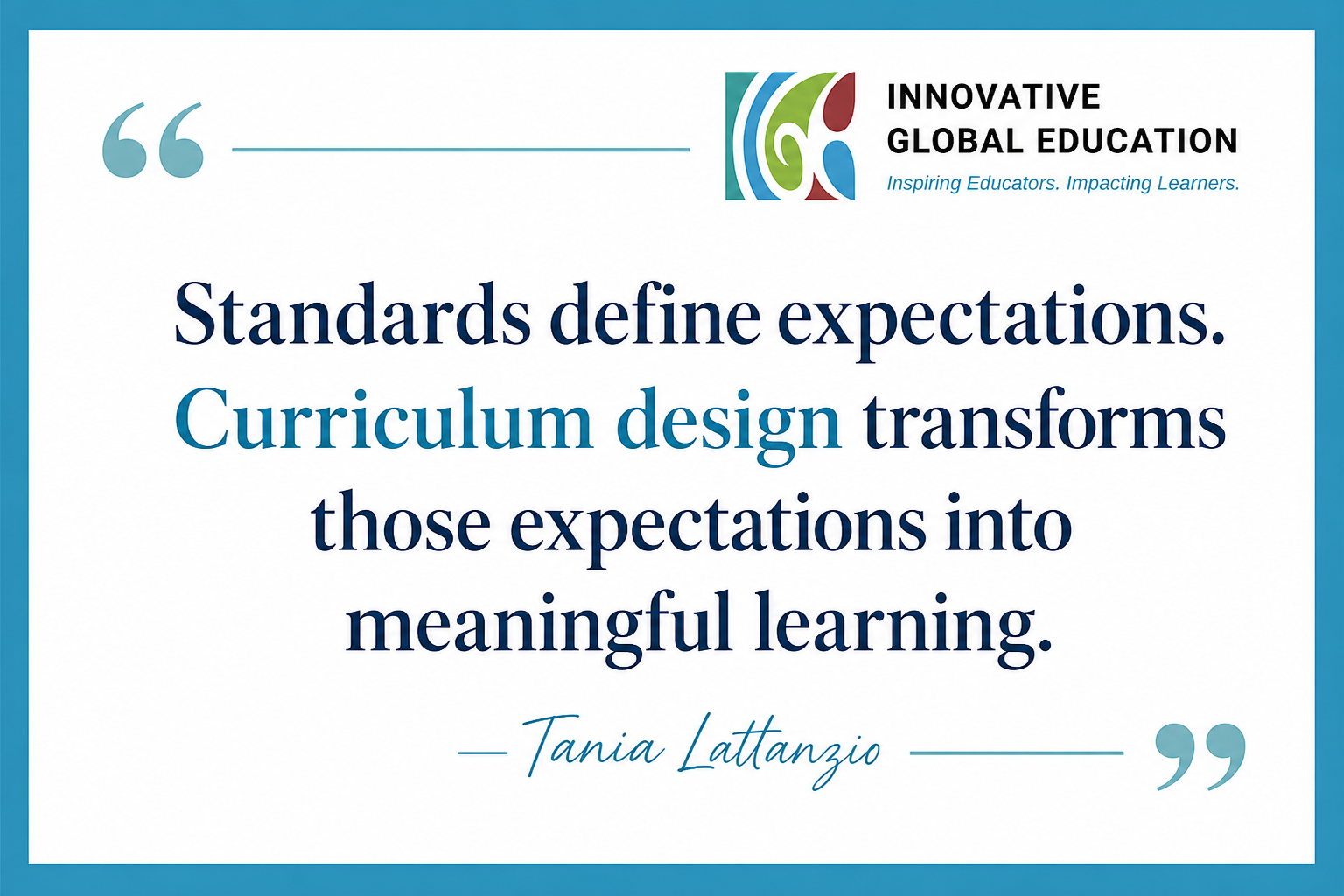
Standards are an essential part of the curriculum, but they are not the learning experience itself. Curriculum comes to life through design.
They are an essential part of the curriculum, but they are not the learning experience itself.
The curriculum comes to life through design.
Curriculum Design Is the Work of Teachers
Curriculum design is one of the most intellectually demanding aspects of teaching.
It is the professional work of making thoughtful decisions about how learning will unfold.
Teachers decide:
What belongs together.
What knowledge is essential.
What experiences will build understanding.
What questions are worth exploring.
When explicit instruction is needed.
Where learners will investigate, collaborate and reflect.
How the curriculum will be assessed.
How ideas will connect over time.
What evidence will demonstrate understanding.
None of these decisions are written in the standards.
They are made by teachers.
That is curriculum design.
Increasingly, thoughtful curriculum design also creates opportunities for learners to contribute to that design. While teachers bring professional expertise and deep knowledge of curriculum, students bring their interests, questions, experiences and perspectives. They may help shape investigations, influence the direction of inquiry, propose authentic contexts or identify issues worth exploring. Curriculum design is not about handing over responsibility; it is about intentionally designing opportunities where learners become genuine partners in the learning journey.
The Invisible Work Between Standards and Learning
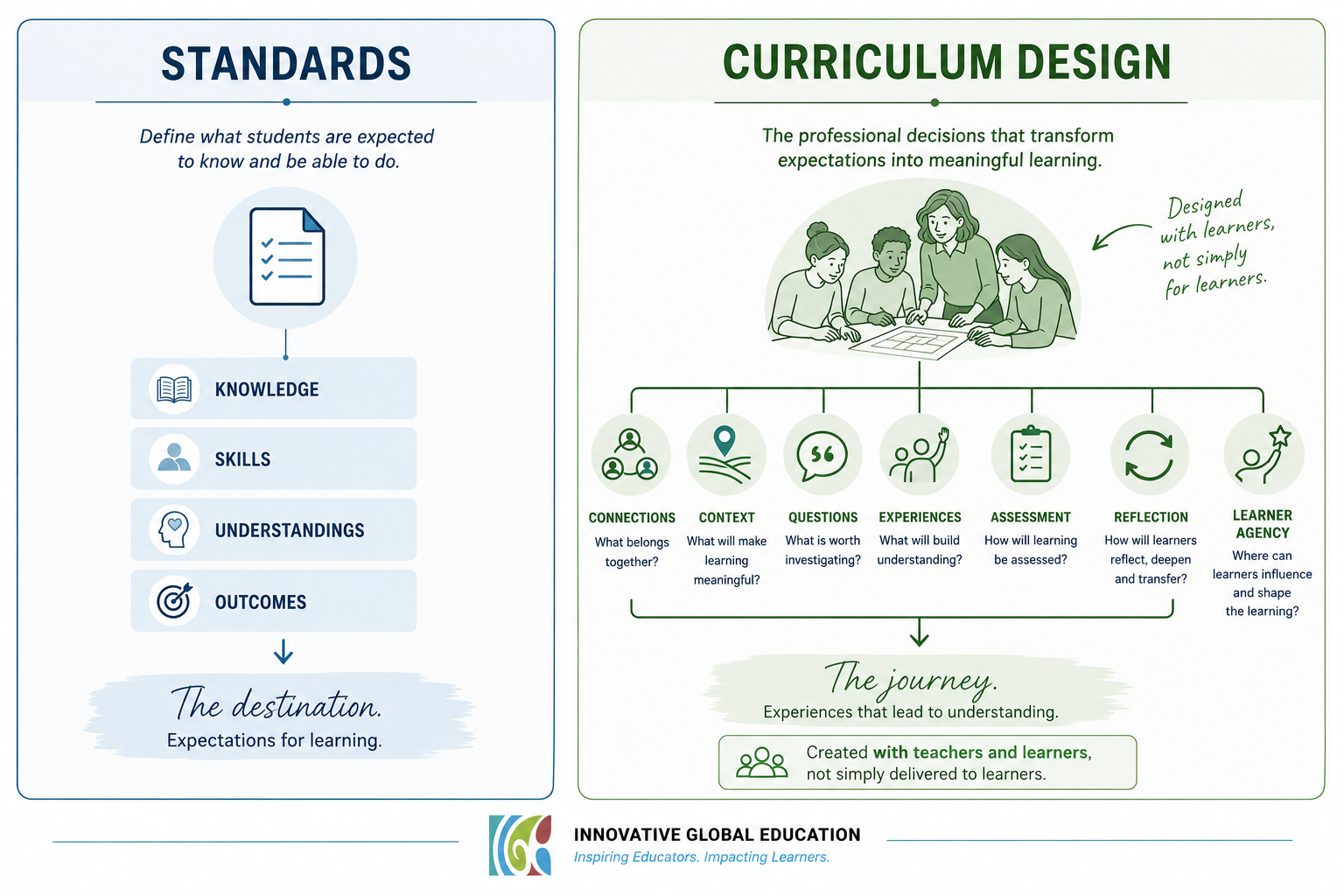
Standards tell us what students are expected to know and be able to do. They do not tell us how students should experience that learning.
They don't tell us:
what context will make the learning meaningful
what questions students should investigate
which ideas naturally belong together
what sequence of experiences will deepen understanding
how learners will transfer their thinking beyond a single lesson.
Those are the decisions curriculum designers make every day.
This is the invisible work of teaching.
It is the thinking that happens between reading the standards and designing the learning.
And it is often the difference between students simply completing curriculum and genuinely making sense of it.
Designing Learning, Not Just Lessons
Imagine you are planning a mathematics unit.
One approach is to teach measurement, geometry, fractions, budgeting and data as separate topics.
Another begins with a meaningful challenge.
Perhaps students are asked to redesign an outdoor learning space for their school.
As they investigate possibilities, they naturally draw upon measurement, geometry, fractions, budgeting, data collection and mathematical reasoning.
The mathematics is the same.
The curriculum expectations are the same.
What changes is the design.
Students experience mathematics as a connected discipline rather than a collection of isolated topics.
The same thinking applies in science.
Rather than teaching habitats, food chains, adaptation and environmental change as separate units, students might investigate a question such as:
How do living things survive and thrive in changing environments?
As they observe organisms, collect evidence, identify patterns and explain relationships, scientific ideas become connected through the investigation rather than being experienced as separate topics.
Or consider social studies.
Rather than moving through geography, history and civics one topic at a time, students might investigate:
How do communities change over time?
They examine historical photographs, analyse maps, interview community members and explore how people, place and decision-making shape the communities they live in today.
Nothing has been removed from the curriculum. The learning has simply been designed differently.
Great Curriculum Doesn't Happen by Accident
Seeing Allison and John's work reminded me that meaningful curriculum design isn't easy. It requires teachers to think beyond individual lessons and isolated curriculum statements.
It asks us to become designers.
To look for relationships.
To organise learning with intention.
To create experiences that help students develop understanding across multiple ideas rather than one objective at a time.
They were also honest. It took more thought. More collaboration. More planning.
But they both agreed it was worth it.
Because students experienced mathematics differently. Not as separate strands to work through. But as something connected. Something meaningful. Something they could apply.
Perhaps that's the real measure of curriculum design.
Not whether students completed every lesson.
But whether they experienced learning as something coherent, purposeful and worth understanding.
Great Curriculum Doesn't Exist in Documents
Students rarely experience meaningful learning because someone faithfully followed a curriculum document.
They experience meaningful learning because teachers intentionally design opportunities to question, investigate, apply, discuss, reflect and connect ideas.
Every authentic investigation.
Every carefully chosen provocation.
Every sequence of learning experiences.
Every discussion.
Every assessment.
Every opportunity to revisit and deepen understanding.
These are acts of design. They are not found in the standards. They are created by teachers.
The Real Question
Perhaps we spend too much time asking,
"Have we covered the standards?"
Maybe a better question is,
"How have we designed learning from them?"
Standards define important learning expectations. Curriculum design transforms those expectations into meaningful learning. The standards provide the destination.
Teachers design the journey.
And perhaps that is one of the most important and often underestimated aspects of our profession.
This post was inspired by reconnecting with Allison Nave and John Willoughby and seeing the thoughtful curriculum design work taking place at Shanghai American School. Thank you both for your willingness to think differently, embrace the complexity of curriculum design and demonstrate what is possible when teachers see themselves not simply as implementers of curriculum, but as its designers.
Continue the Learning
If this article has sparked new thinking about conceptual inquiry, curiosity, and designing learning for deeper understanding, we invite you to continue the journey with us.
📖 Further Reading
Explore our book, Leveraging Deep Learning: Strategies and Tools for Assessment of Conceptual Understanding - a practical resource for educators looking to move beyond surface-level engagement and design learning experiences that foster deeper thinking, transfer, and meaning-making.
🎓 Professional Learning
Take your learning further by joining our upcoming workshop, Designing a Community of Thinkers, with Dr. Jennifer Chang Wathall and Tania Lattanzio. Discover practical strategies for making thinking visible, fostering student agency, and designing learning that builds conceptual understanding.
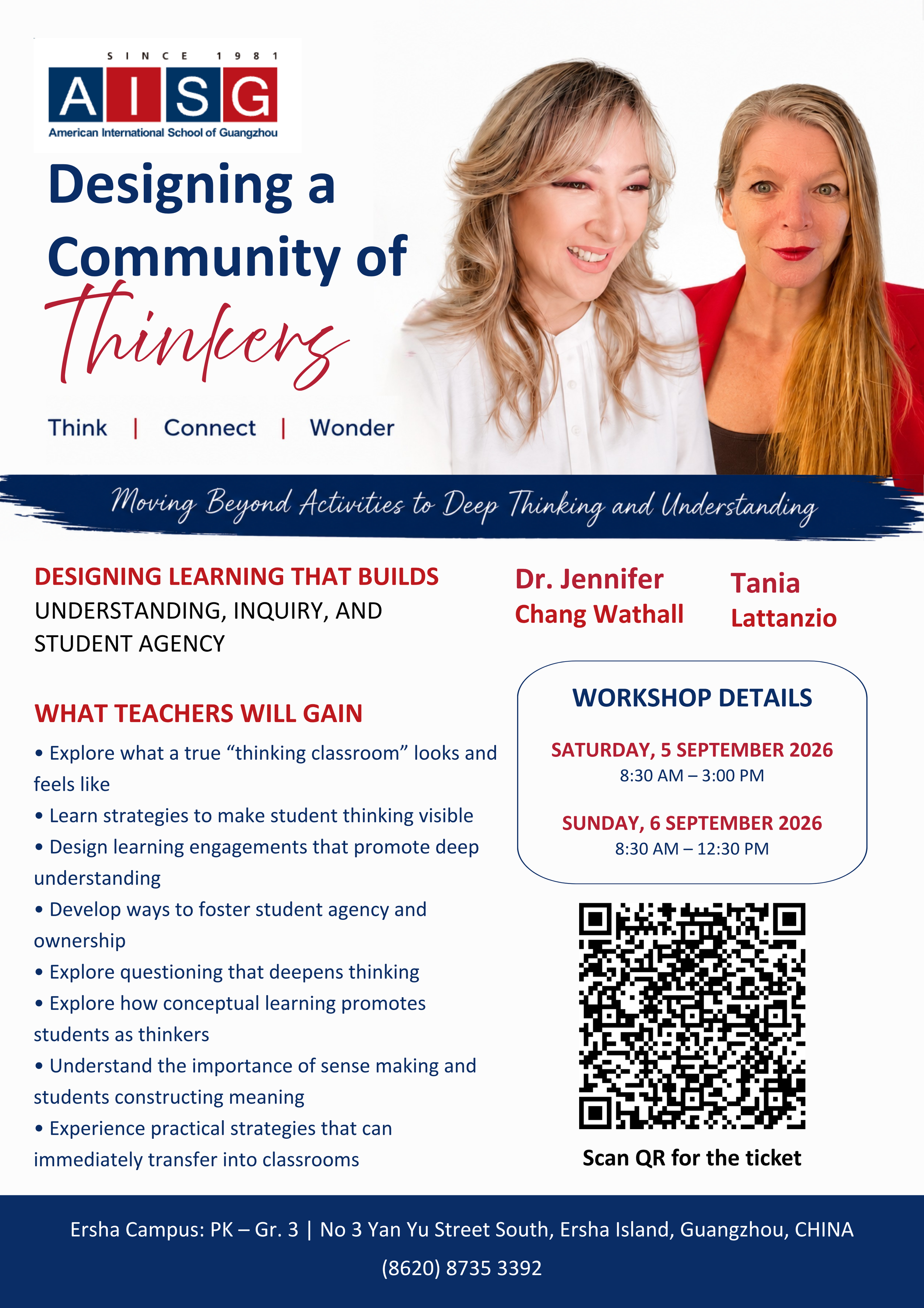
📍 Guangzhou, China
🗓️ 5 – 6 September 2026 (Saturday & Sunday from 8:30 AM to 3:00 PM)
🎟️ Register by 20 July to get the Early Bird discount. Group discounts are also available.
See workshop details and book your tickets here:
https://www.innovativeglobaled.org/events/workshop-designing-a-community-of-thinkers
📧 Contact: info@innovativeglobaled.org
Subscribe to our newsletter to receive future articles, practical resources, and professional learning opportunities on inquiry, conceptual learning, student agency, and learning design.