
Developing Assessment-Capable Learners: A Framework for Understanding Success, Recognising Quality and Using Success Criteria Throughout Learning
In a previous article, I explored how understanding the language of learning provides an important foundation for developing assessment-capable learners. In this article, I want to step back and consider the bigger picture: What capabilities do students need if they are to become active participants in assessment?
Over the past month, I have had the privilege of working alongside teachers in schools across different countries and contexts. While every school is unique, I found myself returning to the same question time and time again.
“How do we actually develop assessment-capable learners?”
Assessment-capable learners are not developed through a single lesson, strategy or assessment task. They are developed gradually through the everyday learning experiences we design and the conversations we have with students about learning.
Throughout Leveraging Deep Learning: Strategies and Tools for Continuous Assessment of Conceptual Understanding, Andrea Müller and I argue that continuous assessment is not simply about collecting evidence of learning. It is about developing learners who increasingly understand the learning, recognise quality, gather evidence and make informed decisions about their next steps.
“Continuous assessment is not something we do to learners. It is something learners increasingly do with us and eventually for themselves.”
While the research provides an important foundation, the purpose of this article is to share a practical process that has emerged through working alongside teachers as they explore how assessment can become something students actively use throughout learning.
At its heart, this requires a shift in who is doing the thinking in the classroom. At times, teachers do the analysing, judging and deciding, while students wait for feedback. If we genuinely want students to become assessment-capable learners, they need to be doing more of the thinking.
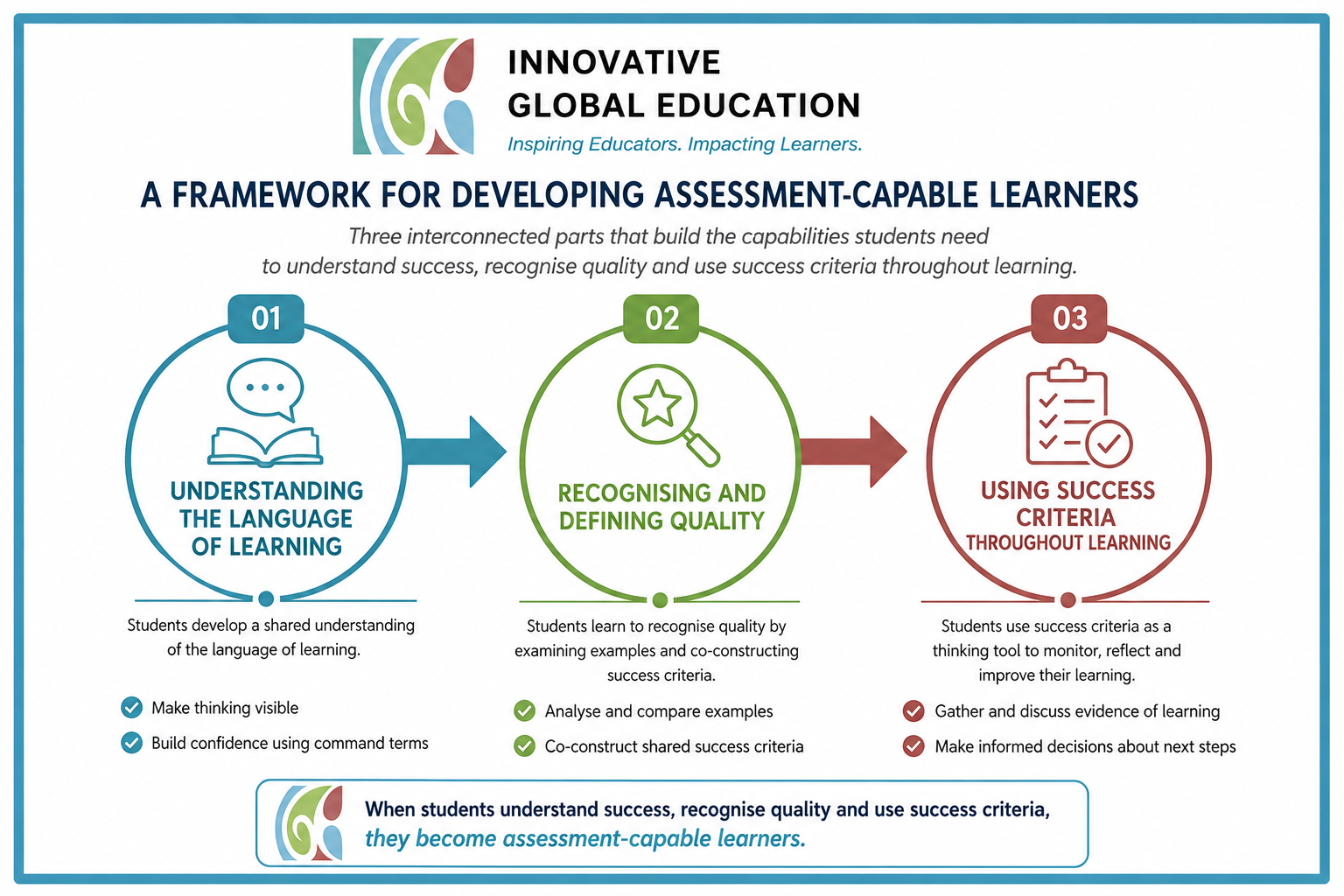
Through collaborating with schools across different countries and contexts, I have found myself returning to the same process time and time again. While every classroom is unique, developing assessment-capable learners consistently involves three interconnected parts: understanding the language of learning, recognising and defining quality, and using success criteria throughout learning. The framework that follows has emerged through this work alongside teachers and continues to evolve as schools explore how continuous assessment can position students as assessment-capable learners.
The framework below illustrates the three interconnected parts of developing assessment-capable learners. Each part builds on the previous one, creating a continuous process rather than a sequence of isolated strategies.
Part One: Understanding the Language of Learning
Before students can recognise quality, they first need to understand the language of learning. We often assume students understand command terms such as describe, explain, analyse, justify and evaluate, yet these words represent different kinds of thinking.
Understanding the language of learning is about much more than defining vocabulary; it is about making thinking visible and developing a shared understanding of command terms.
Students need repeated opportunities to explore examples, compare responses and discuss what different kinds of thinking look like before they can meaningfully use success criteria.
Learning Experience: Unpacking the Language of Learning
Purpose
To help students develop a shared understanding of the language of learning by exploring what different command terms look like in authentic examples.
What Students Do
Students examine several short examples that demonstrate a command term such as explain, analyse or justify. They discuss what the learner is doing, identify evidence of the thinking, compare ideas with peers and co-construct a shared definition that is revisited throughout the unit.
Why it Matters
Students develop an understanding of the thinking behind the language rather than memorising definitions, making success criteria and feedback far more meaningful.
Learning Experience: Highlight the Thinking
Purpose
To help students recognise where different kinds of thinking occur within authentic responses.
What Students Do
Students use coloured highlighters to identify where an exemplar is describing, explaining, analysing or evaluating, justifying their decisions through discussion.
Why it Matters
Students begin recognising patterns of thinking and become more confident using command terms in their own work.
Learning Experience: Command Term Sort
Purpose
To help students compare different kinds of thinking and recognise the subtle differences between command terms.
What Students Do
Students sort short examples under command term headings, debate their choices and refine class definitions through evidence-based discussion. They then develop an anchor chart that has the command terms on it as well and other language that connects to that term. This can be revisited throughout the learning.
Why it Matters
Students actively construct their understanding of the language of learning rather than passively receiving teacher definitions.
Reflection
Understanding the language of learning is not about teaching students the definitions of command terms. It is about helping students understand the different kinds of thinking that learning requires.
When students can recognise the difference between describing, explaining, analysing, justifying and evaluating, they become better equipped to interpret success criteria, engage meaningfully in feedback and communicate their thinking with greater confidence.
Without this shared understanding, success criteria can remain open to interpretation, with teachers and students often attaching different meanings to the same words.
Developing a shared language of learning creates the foundation for everything that follows.
Only when students understand the language can they begin to recognise quality, define what successful learning looks like and increasingly use success criteria to guide and improve their own learning.
Part Two: Recognising and Defining Quality
Once students understand the language of learning, they are ready for the next part of the process: recognising what quality actually looks like.
At times, success criteria are written by the teacher, shared with students at the beginning of learning and revisited only when the task is complete. While students may be able to read the criteria, this does not necessarily mean they understand what quality looks like in practice.
Recognising quality requires more than reading a list of expectations. Students need opportunities to examine examples, compare different responses, justify their thinking and identify the characteristics that make learning increasingly successful.
Research suggests that students develop stronger understandings of quality when they actively engage with success criteria rather than simply receiving them (Willis, Arnold, & DeLuca, 2023).
Rather than teachers defining quality for students, students begin constructing an understanding of quality for themselves. Through carefully designed learning experiences they compare examples, justify their thinking, challenge one another's ideas and co-construct success criteria with their peers and teacher. These conversations build a shared understanding of quality, ensuring success criteria become something students understand and use rather than something they simply receive.
Learning Experience: Gallery of Quality
Purpose
To help students identify the characteristics of successful learning by analysing authentic examples.
What Students Do
Students examine several anonymous examples of work representing different levels of quality. Working collaboratively, they discuss what the learner does well, what evidence demonstrates quality, which success criteria they can identify and what advice would strengthen the work. The class records the characteristics that consistently emerge and uses these observations as the foundation for the success criteria.
Where opinions differ, students are encouraged to justify their thinking using evidence from the work rather than simply agreeing or disagreeing. It is often these conversations that deepen students' understanding of quality.
Why it Matters
Students begin recognising that quality has identifiable characteristics and learn to notice, discuss and justify quality for themselves.
Learning Experience: Developing a Rubric for Understanding
Purpose
To help students understand that quality develops along a continuum by co-constructing a developmental rubric.
What Students Do
Students arrange four or five anonymous work samples along a continuum from developing understanding to increasingly sophisticated understanding. They justify their decisions using evidence before co-constructing descriptors that describe how understanding develops at each point on the continuum. The completed rubric becomes a roadmap that is revisited throughout the unit.
As learning progresses, revisit the continuum, inviting students to add new examples or reposition existing ones as their understanding develops.
Why it Matters
Students see learning as a progression rather than something that is simply right or wrong and begin asking, 'What does increasingly sophisticated understanding look like?'
Learning Experience: Developing a One-Point Rubric
Purpose
To create a shared understanding of expected quality while providing students with a tool they can use throughout learning.
What Students Do
Using the agreed success criteria, students co-construct a one-point rubric describing the expected level of performance. Throughout the unit they record evidence of learning, note strengths, capture feedback and identify meaningful next steps, continually adding to the rubric as their understanding develops.
One-point rubrics work particularly well because they focus attention on the expected level of quality while leaving space for students to record evidence of learning, feedback and next steps.
I often use the headings Exploring, Meeting and Going Further. The language is intentional. Exploring acknowledges that learning is still developing and reinforces that understanding grows over time rather than suggesting students have failed to meet expectations.
Why it Matters
A one-point rubric shifts the focus from judging completed work to improving learning while it is happening. Success criteria become a thinking tool rather than a checklist.
Reflection
Recognising quality is not about asking students to memorise success criteria. It is about creating opportunities for them to explore, discuss and understand what successful learning looks like. When students help develop success criteria, construct rubrics for understanding and use one-point rubrics throughout learning, success becomes visible. Only then do success criteria become a tool students use to guide and deepen their own learning.
Part Three: Using Success Criteria Throughout Learning
Developing success criteria is only valuable if students learn to use them.
Often, success criteria are introduced before learning begins and then revisited only when students submit their work. When this happens, they become little more than a checklist completed at the end of the learning process.
Continuous assessment asks us to think differently.
Rather than viewing success criteria as something students read once, we want them to become a tool students use throughout learning to monitor their progress, gather evidence, seek feedback and determine meaningful next steps.
Success criteria should become part of everyday classroom conversations.
As students work, they continually ask themselves:
Which success criteria am I demonstrating?
What evidence supports my thinking?
Which criteria am I still developing?
What do I need to do next?
When students begin asking these questions independently, assessment shifts from something managed by the teacher to something students actively use to improve their own learning.
Learning Experience: Evidence Highlighting
Purpose
To help students identify where they have demonstrated each success criterion within their own work.
What Students Do
Before submitting or sharing their work, students revisit the success criteria and use different colours to highlight where they believe they have demonstrated each criterion. Alongside each highlight they write a brief annotation explaining how that section provides evidence of the criterion. If students cannot find evidence for a particular criterion, they strengthen their work before seeking feedback.
Why it Matters
Students begin identifying evidence for themselves rather than relying on the teacher to point it out. Success criteria become a tool for reviewing and improving learning before assessment occurs.
Learning Experience: Success Criteria Conferences
Purpose
To support students in using success criteria to engage in meaningful conversations about their learning.
What Students Do
Working with a peer (critique groups of 3 can be useful for building assessment capable learners) or teacher, students bring their work and the success criteria to a short conference. They explain which criteria they believe they have demonstrated, what evidence supports their thinking, which criterion they are still developing and what feedback would help them move forward. They finish by identifying one or two clear next steps.
Why it Matters
Students become active participants in feedback conversations and learn to use success criteria to guide discussion about their own learning.
Learning Experience: Making Success Criteria Visible
Purpose
To help students continually build a shared understanding of quality by making success criteria visible and using authentic examples of learning to illustrate what success looks like in practice.
What Students Do
Display the success criteria, one-point rubric or rubric for understanding in a highly visible place within the classroom or on a shared digital platform where students can revisit it throughout the unit.
As learning progresses, invite students to select work samples, photographs, recordings, models, artwork, videos or teacher observations that they believe demonstrate particular success criteria.
Students attach each example beside the relevant success criterion or within the appropriate section of the rubric, explaining why they believe it demonstrates that aspect of quality.
As more examples are added, encourage students to compare them by discussing questions such as:
What makes this example a strong demonstration of this criterion?
How is this example different from one we added earlier?
Which example best represents this criterion and why?
Has our understanding of this criterion changed as our learning has developed?
Through these conversations, students begin moderating their understanding of quality together. The display becomes a living collection of authentic examples that continues to evolve throughout the unit, serving as a reference point whenever students are planning, seeking feedback or improving their work.
Why it Matters
Success criteria become visible, meaningful and continually evolving rather than remaining static statements on a wall or in a document. As students add, compare and discuss authentic examples of learning, they deepen their shared understanding of quality and increasingly moderate their thinking together. Over time, the display becomes a powerful learning tool that students naturally use to monitor their progress, identify next steps and develop increasingly sophisticated understandings of quality.
Because the display continues to evolve throughout the unit, students see that understanding develops over time. Success criteria become more than statements of expectation; they become a shared reference for learning conversations, feedback and continuous assessment.
Reflection
Success criteria are not designed to sit on the wall or remain at the top of a task sheet. They are designed to be used. When students return to success criteria throughout learning, they begin recognising evidence of their understanding, making informed decisions about their next steps and taking increasing ownership of their learning. This is where continuous assessment becomes visible.
Success criteria become tools that help students understand, monitor and deepen their own learning.
Conclusion
Developing assessment-capable learners is not about introducing another strategy, another rubric or another reflection activity. It is about changing the role students play in assessment.
When students understand the language of learning, recognise what quality looks like and use success criteria throughout learning, assessment becomes more than a way of measuring achievement. It becomes a process that helps students understand how learning develops and what they need to do next.
Over time, students move beyond asking, 'Is this right?' They begin asking richer questions such as, 'What evidence demonstrates my understanding?', 'Which success criteria have I met?' and 'How can I strengthen my learning further?' These are the questions assessment-capable learners ask because they are increasingly doing the thinking that was once the responsibility of the teacher.
This is not about teachers stepping away from assessment. Rather, it is about intentionally transferring increasing responsibility to studentsso they become active partners in understanding, interpreting and using evidence of learning.
When students understand success, recognise quality and continually use success criteria to guide their decisions, assessment shifts from something that happens to learners to something learners increasingly do for themselves.
Ultimately, that is the purpose of continuous assessment.
Not simply to improve assessment.
But to develop assessment-capable learners who know how to learn.
References
Lattanzio, T., & Müller, A. (2025). Leveraging Deep Learning: Strategies and Tools for Continuous Assessment of Conceptual Understanding. Corwin.
Willis, J., Arnold, J., & DeLuca, C. (2023). Accessibility in assessment for learning: Sharing criteria for success. Frontiers in Education, 8.
Further Reading & Professional Learning
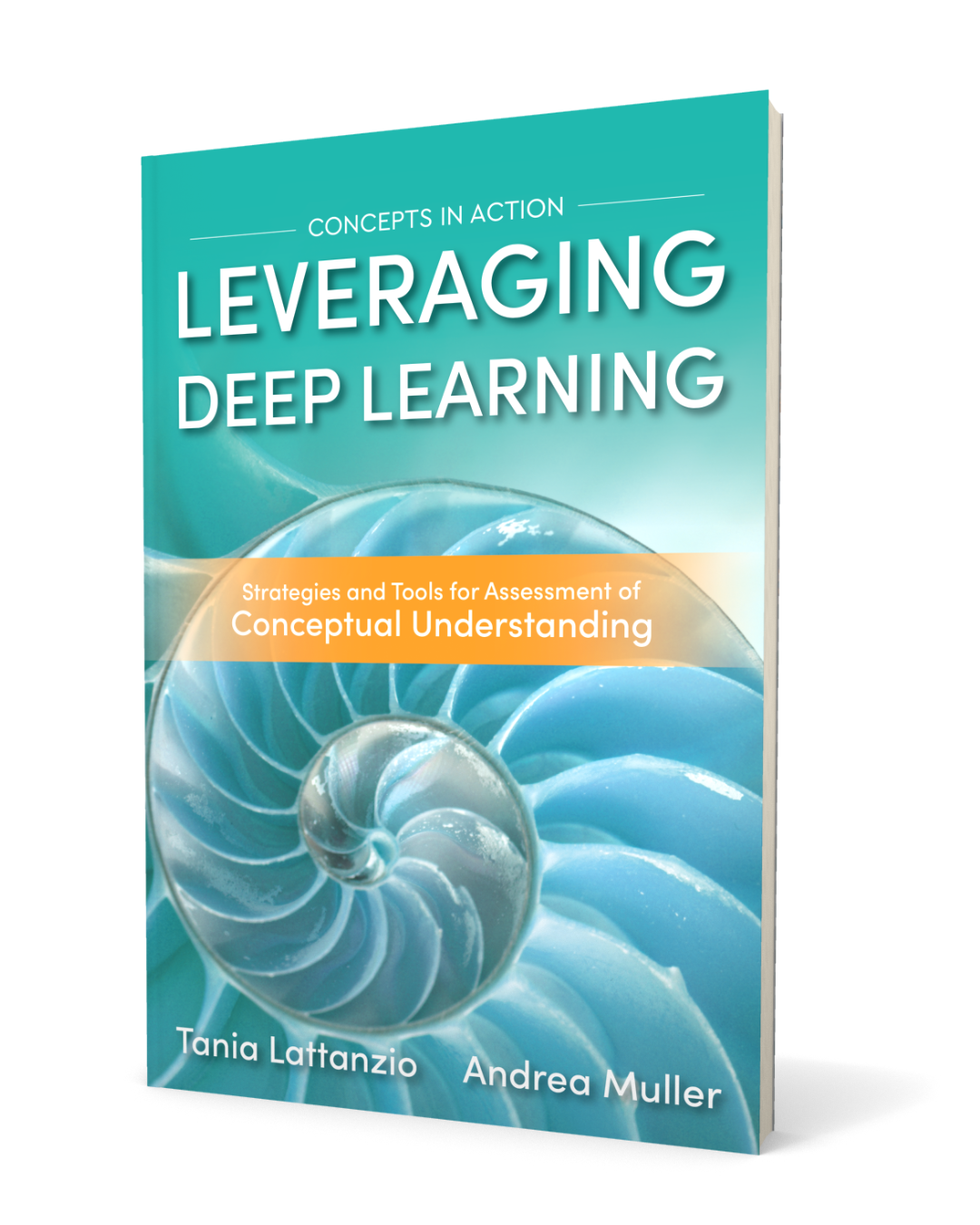
If you found this conversation around curiosity, inquiry, and conceptual understanding helpful, I highly recommend exploring our book:
Leveraging Deep Learning: Strategies and Tools for Assessment of Conceptual Understanding - A thoughtful resource for educators looking to move beyond surface-level engagement and design learning experiences that foster deeper thinking, transfer, and meaning-making.
You can also explore more articles, latest workshops, consulting services, and professional learning opportunities through Innovative Global Education:
Visit our website: https://www.innovativeglobaled.org
Get in touch: info@innovativeglobaled.org
Subscribe to our newsletter to stay connected with future reflections and resources on inquiry, learning design, student agency, and more.