
Who is Doing the Thinking…… and the Designing?
When I visit schools, there are three questions I find myself returning to again and again.
Who is doing the thinking?
Who is doing the talking?
How intentionally has the learning been designed so that both are possible?
The quality of learning is often determined less by the activity we plan and more by who is doing the intellectual work within it.
Learning isn't simply about students being busy or engaged. Deep learning occurs when students are making meaning, noticing patterns, questioning assumptions, explaining their thinking, justifying decisions and connecting ideas.
Dialogue sits at the heart of that process. Neil Mercer's research reminds us that purposeful classroom dialogue does more than reveal thinking; it helps develop it. As students explain, question, justify and build on one another's ideas, they refine their own understanding while learning from the perspectives of others.
Yet rich thinking and purposeful dialogue rarely happen by chance. They are intentionally designed.
Inquiry is not the absence of teaching. It is the intentional design of learning that positions students to do the intellectual work. Teachers remain essential, not as the primary thinkers, but as designers of learning experiences that cultivate curiosity, dialogue, reasoning and understanding.
But recently I have found myself adding another question:
Who is doing the designing?
Powerful learning requires intentionality. We need clarity about what we are designing for and why. We need to know our learners, anticipate variability and barriers, and consider access, participation, belonging and challenge from the outset.
This design work is also increasingly collective. Different educators bring different knowledge, perspectives and expertise. Co-design is more than dividing up the planning; it is bringing our thinking together so that different expertise influences the same learning design.
This came into sharper focus recently while working with educators at the International Community School of Addis Ababa, where we spent two days exploring what it means to design learning together.
How might our collective expertise enable every learner to belong, participate and learn?
Influenced by the work of Anne Knock around intentional learning design, we considered what needs to be thought about before learning begins: purpose, knowledge of learners, potential barriers, access and participation, collective expertise and the evidence we might gather.
But as our thinking developed, another question became increasingly important:
If we are designing learning so purposefully, where are the learners in the design?
What doesn't need to be decided by us?
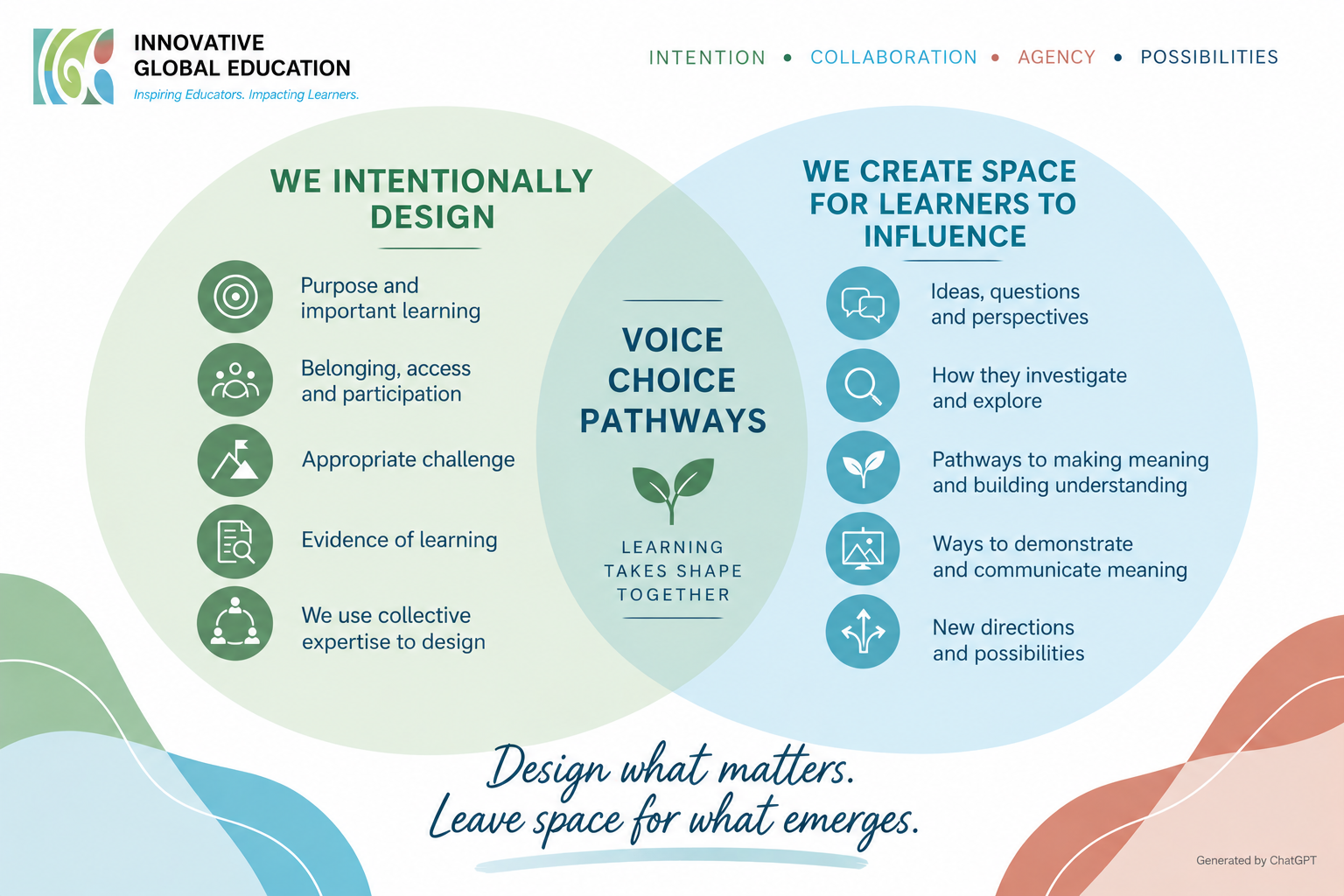
There are things we need to design as educators. We bring knowledge of curriculum, concepts, progression and pedagogy. We need clarity about the learning that matters and have a responsibility to create conditions in which every learner can access, participate, belong and experience appropriate challenge.
But purposeful design does not mean deciding everything in advance. This opens up a different set of questions:
Could learners influence the questions they pursue?
Could they make meaningful decisions about how they investigate and explore?
Could they influence the pathways they take to make meaning and build understanding?
Could they determine ways to demonstrate and communicate meaning?
Could their questions, theories and interests take the learning somewhere we had not anticipated?
In ICS Addis, we explored this through voice, choice and pathways: the different ways learners might influence learning, make meaningful decisions within it and take different routes towards shared learning intentions.
Providing choice does not necessarily mean learners have voice. Different activities do not automatically create different pathways. And involving learners in design does not mean handing every decision to them.
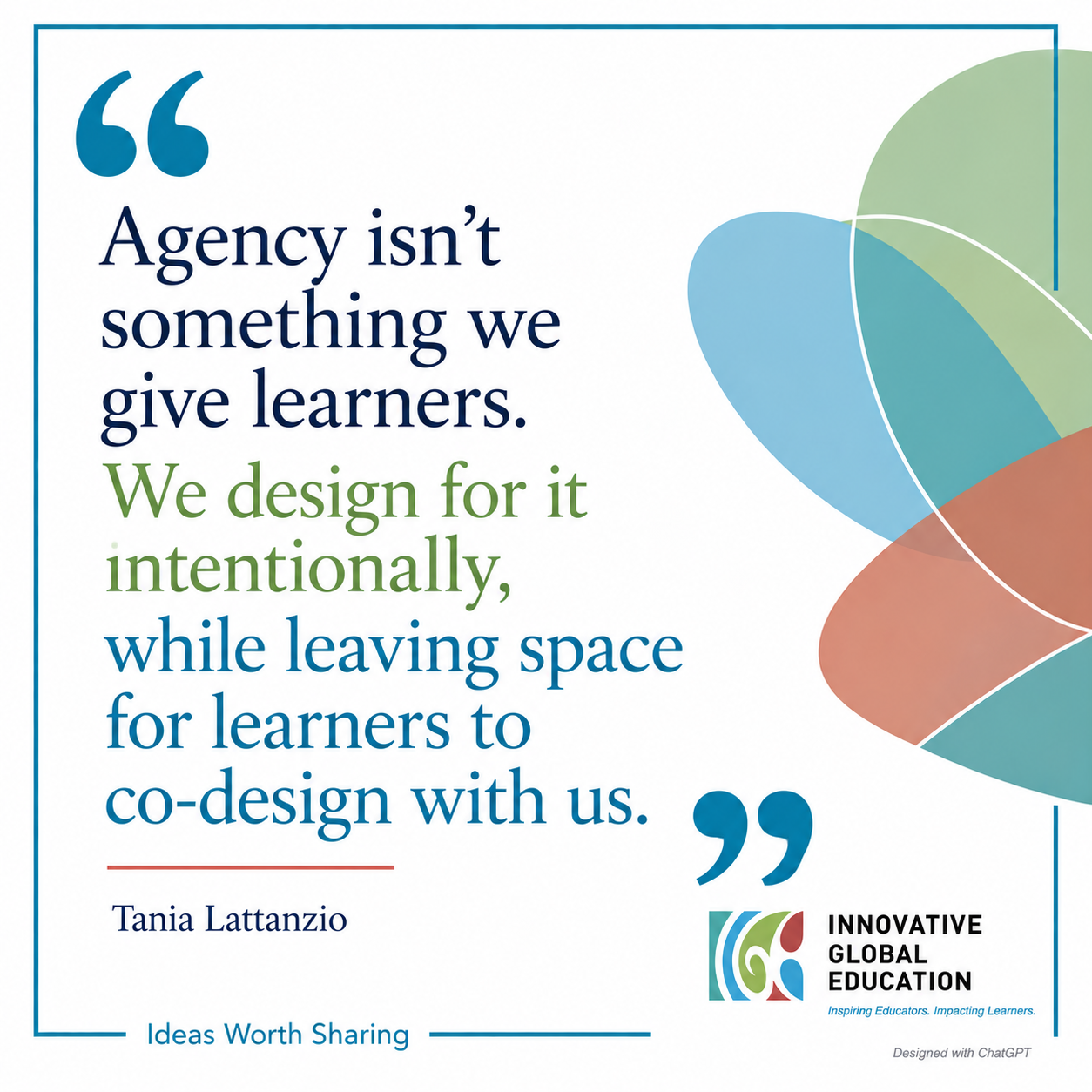
Perhaps learner agency doesn't require us to design less. It requires us to design differently.
To design with enough clarity that learning has purpose, but enough openness that learners can genuinely influence what happens within it.
Carlina Rinaldi reminds us that listening is itself a pedagogical act. When we genuinely listen to students' theories, questions and interpretations, their ideas begin to shape the learning rather than simply respond to it.
Design must remain responsive
There is another reason we cannot design everything in advance: we don't yet know what learners will show us.
A learner may make a connection we hadn't anticipated. A grouping may not work. Someone may need greater challenge. A question may open a possibility we hadn't considered.
This is where purposeful design becomes responsive.
Instead of asking:
Are we following the plan?
we ask:
What are learners showing us, and what might we do next?
Responsive teaching means paying attention to the evidence learners give us and being willing to adjust the learning in response.
Leave space in the planning.
Not because we haven't thought carefully enough about the learning, but because we have deliberately created room for learners to influence it.
Who is doing the thinking and the designing?
Perhaps co-design isn't simply something that happens between adults in a planning meeting. And involving learners in design isn't a single moment when we ask them what they would like to do.
It is an ongoing relationship between intention, listening, evidence and response.
We design. Learners respond. We notice. Learners contribute. We listen. We interpret. And the design evolves.
The OECD Learning Compass 2030 describes learner agency through the capacity to anticipate, act and reflect. Agency does not emerge simply because we tell students to take ownership. It develops through intentionally designed experiences in which learners gradually take increasing responsibility for their thinking and learning.
So perhaps there are now four questions I find myself returning to:
Who is doing the thinking?
Who is doing the talking?
Who is doing the designing?
How intentionally have we created the conditions for all three?
Powerful learning requires intentional design. But perhaps the most powerful design is not the one that anticipates everything. It is the one that is clear about what matters, purposefully creates the conditions for learning, and leaves enough space for learners to influence what becomes possible.
Design with intention.
Listen with curiosity.
Respond to what emerges.
Perhaps that is how we move from designing learning for learners towards increasingly designing learning with them.
References
Claxton, G. (2002). Building Learning Power. TLO Limited.
Knock, A. (2024). School by Design: Transforming Learning, Culture and Place. Amba Press.
Mercer, N., & Littleton, K. (2007). Dialogue and the Development of Children's Thinking. Routledge.
OECD. (2019). OECD Learning Compass 2030: A Series of Concept Notes. OECD Publishing.
Rinaldi, C. (2021). In Dialogue with Reggio Emilia: Listening, Researching and Learning (Updated ed.). Routledge.

Further Reading & Professional Learning
If you found this conversation around curiosity, inquiry, and conceptual understanding helpful, I highly recommend exploring our book:
Leveraging Deep Learning: Strategies and Tools for Assessment of Conceptual Understanding - A thoughtful resource for educators looking to move beyond surface-level engagement and design learning experiences that foster deeper thinking, transfer, and meaning-making.
You can also explore more articles, latest workshops, consulting services, and professional learning opportunities through Innovative Global Education:
Visit our website: https://www.innovativeglobaled.org
Get in touch: info@innovativeglobaled.org
Subscribe to our newsletter to stay connected with future reflections and resources on inquiry, learning design, student agency, and more.